

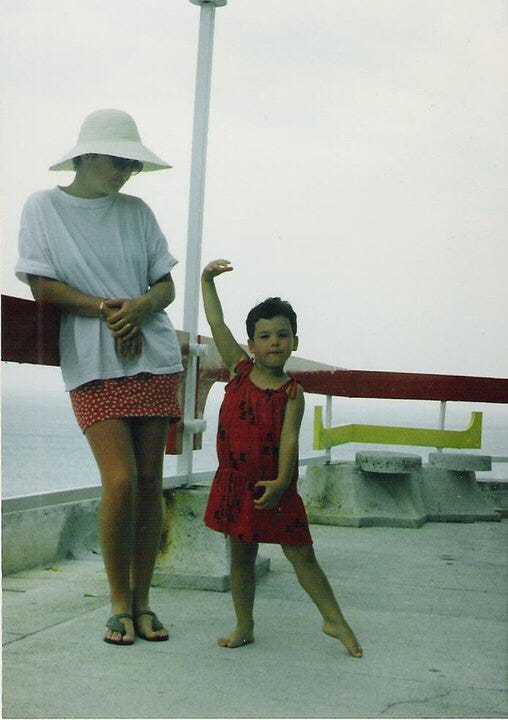
I am pressing my nose to the ice cold window, careful not to fog it up with my breath. My ears are pricked up, trying to catch any sound from the street. I am waiting for a car, my parents’ car, to hear the engine and then see it turn left into the parking spot in the corner, my mom climb down and hurry toward our building, prove that she is not dead. I unglue myself from my posting for a few minutes and start spinning in circles until I feel like I’m going to throw up. But there has been no change, the parking spot lies empty. My grandparents are watching TV in the living room, dozing off in the heat coming off the radiators, empty cups of cumin tea resting on the sides of their armchairs. I make for the door as quietly as I can and once I am on the other side, I run down the two flights of stairs, onto the dark street, sprinting between entrance B where my grandparents live and entrance D where we live. Maybe I’ll see the light on in their bedroom, the car parked elsewhere, my mom taking off her blue and green earrings and putting them in the jewelry box I like before calling the landline to tell my sister and me that they are home and that we can come home too. But there’s no light in the window, no car, and I have been outside in nothing but a t-shirt on a Saturday night in January. If I catch a cold, my mom will be upset.
This morning we’re on our daily FaceTime. It’s 10 in the morning in Austin, 7 in the evening in Bucharest, and I am walking to the gym while she sits in her spot on the sofa, having just put a book down. She’ll get up and have a snack standing over the kitchen sink while I update her on the small accumulation of nothings from the previous day. Then I’ll start yelling at her for not sitting down while eating. She’ll say it’s just a snack. She’ll ask about my husband. We’ll rehash, for the thousandth time, the plan for when we have a baby and she comes over to help. The thing we are both waiting to happen, that hasn’t happened yet. I hang up and go about my day, knowing I’ll call her again tomorrow.
Even before hearing the stories of my coming into the world — an ominous night, a difficult labor, a more difficult birth, an earthquake, a single mother — I had an intense need to feel safe. As a child, I gave my mother the role of caretaker, protector, center of my universe. It wasn’t only love, though I loved her fiercely and adored many things about her: the way her feet arched even though I was the one doing ballet, the sandals she bought one summer and the click of the heels on the pavement, the way she always kissed me goodnight and how we had “conversations” instead of playing. But now my husband takes care of me, kisses me goodnight, provides, makes me feel safe. I don’t need my mother anymore.
When I was about 6, she was taking me to ballet class. We were walking hand in hand when she stopped, looked me in the eye, and told me I was her best friend in the entire world. I was still beaming when I took my place at the barre and saw her watching me, the way she always did. Every class, the other mothers waited outside, smoking, exchanging gossip, while my mom stood by the piano in the corner of the studio, never taking her eyes off me. She encouraged me when I did something well, shook her head when I let my attention drift to everything else in the room instead of to the steps I had just learned. Full and complete presence, and earnest interest too.
I imagine taking my future kids to their ballet class and watching them plop away for hours on end. How boring. I will not have what she had.
Everything I hate about my mother is what I hate about myself most, and everything I love about her, I didn’t inherit and will likely not pass on: the patience to read Ulysses, not because it’s fun or enjoyable but because one must not remain simply a creature of ease. An inclination toward self-sacrifice. The kind of idealism that borders on naiveté and has somehow not been perverted, even though life has shown her plenty of times it should be. The ability to not be bored by her children in an actual, real way. She watched me at the barre for years, and I cannot imagine doing the same.
Then there are the bad ones. The crippling separation anxiety of my childhood has morphed, in adulthood, into a plain everything-anxiety. The mirror image of hers. I’m no longer terrified of her being dead if she hasn’t come back from taking the trash out within the 30 seconds I deemed necessary for completing the task, but I catastrophize in myriad other ways. I might not have gotten her blue eyes and lithe legs, but I slip into sadness, melancholy, and overthinking that becomes paralysis just as easily as she does.
Our circumstances couldn’t be more different. And yet I am afraid that for me too, motherhood will be the playpen that allows me to be remarkable only in ways that don’t convert into a public life. I didn’t grow up weighed down by the same fear and shame, but I have kept finding my own reasons not to close the gap between what I think I am capable of and how much I am willing to give myself to the work. The armchair intellectual is a family heirloom I do not wish to keep.
When I left home at 19 to study in London, she sent me off with a smile and a notebook she had hidden in my suitcase, every page written for me in the months before my leaving. She let me go even though parting cost her something she never recovered from. Since then, every time we see each other, one of the first things we do is fight. Or as Annie Ernaux put it, we “address each other in that particular tone of speech — a cross between exasperation and perpetual resentment — which led people to believe, wrongly, that we were always arguing. I would recognize that tone of conversation between a mother and her daughter anywhere in the world.” We fall into it because I don’t let her mother me, don’t listen to what she tells me — because I am how I remember and imagine her at my age, strong-willed, answering to no one. Although I open the notebook more often than she knows.
We were on a family trip a few months ago, and I kept getting annoyed at my mom for engaging in what I called “old woman” behaviors: putting an extra layer on when we went for a walk, not responding immediately to the machine-gun speech I sometimes favor, fiddling with her iPhone. It wasn’t just my lack of patience but a contradiction to an image I have carried — me coming from school and seeing, from the other side of the street, my mom returning from the market with her arms full of bags, walking so fast, her eyes moving everywhere all at once, full of vitality and youth. I forget that 30 years have passed since that memory and can only see her as two disparate points: the perfect image of my young mother, and the one from today, smaller, slower, unfamiliar. In my mind’s eye, I am exactly who she was when I watched her come from the market — a woman full of force, young, strong-willed, unbreakable. I am becoming the woman coming from the market, the one she no longer has access to.
These days I imagine her dead, but unlike when I was 6, I do it on purpose, to convince myself it wouldn’t devastate me, that I would be perfectly able to carry on. I tell myself I don’t need her because my husband keeps me safe, taken care of, alive. I tell myself my husband’s loss would be worse. A half-truth at most: the life we have built together makes losing him unimaginable for reasons that have nothing to do with safety. It is also a calculation I keep returning to in order to manage a fear I don’t want to look at directly. But these fantasies are not less foolish for being rehearsed.
I share my mother’s cynicism — a paradoxical trait for an idealist — and like her, I am usually right. People do turn out to be exactly who we suspect they are. But I wish we were wrong. If she were wrong, I could be wrong too, and I could believe in more things. Our worldviews, like the branches of a tree, have grown in separate directions, but they share a root.
Moving around other people I love is easier because I don’t see myself in them as much, and therefore a part of me remains just mine. There are ways I feel and see the world that I know only my mother understands, and sometimes I don’t wish to share them with her in spite of our kinship, as if her understanding were more painful than the loneliness of keeping them to myself. “I will always know when you’re telling the truth or when you’re lying, because I am the queen of lies,” she used to tell me when I was little. She meant: I will always know. It’s not that her understanding makes them inheritances; it’s that her understanding leaves me nowhere to hide.
For the longest time, I thought my ambivalence toward motherhood was rooted in perceiving children as obstacles to achieving what I have not yet achieved. A way of transferring the obstacle from my own limitations to something concrete I could blame. But the deepest fear is that I would no longer belong to myself. The freedom and autonomy I cherish are not the external measures — time, mobility, independence — but the interior territory, the part of myself that remains mine alone. The quality of presence that has made my mother so profoundly a mother — the attention, the non-boredom, the long unbroken hours of presence — required her to give herself entirely. I am not certain it is compatible with the part of me I want to keep, with the desire to cordon off a slice of myself, to insulate it even from my own child.
And so I need her. What I have to ask of my mother is that she continue to be present, to give attention, to do the work of mothering so that I am able to be a different kind of mother — perhaps a lesser one, but one who doesn’t have to pay the price of her entire selfhood. I need her labor to protect the room that isn’t something to cling to for its own sake but the place where my ideas can exist. She didn’t get to keep both. The qualities I admire in her, the ones I did not inherit, are the qualities I am asking her to continue performing on my behalf. I am asking her to remain the version of herself that paid the price I am trying to avoid paying.
She cannot wait to do it. She already talks about separate homes — not as a metaphorical room of one’s own, but as a space nearby, where she can take the future child from my hands. Stretches of time that would allow for work, for a life with my husband.
In our conversations, she has told me about her regrets, what she once dreamed of becoming and didn’t, the way children do not make up for the losses. But she does not believe motherhood was what stopped her. In her telling, it was the conditions of her life and the choices those conditions produced. The children were the good thing, not the obstacle. I am asking her on terms she would dispute. The inheritance I have been managing through writing and autonomy is in me whether or not I have a child, and motherhood, I fear, would be the thing that lets it loose.
On FaceTime, I wait for her to pick up, always a little too long. Somewhere in the middle of the daily updates, I ask her the names of things I have forgotten — a book I loved when I was five, the number of the apartment we lived in 30 years ago, a person I have a distant memory of. She remembers everything I do not.
Before we hang up, she calls me chifteluță. Little meatball. Cine nu are chiftea ca a mea — who doesn’t have a meatball like mine should get one. I do not say what I think. I say goodbye.
❤️❤️❤️💔💔💔 I hope you get one like mine.