

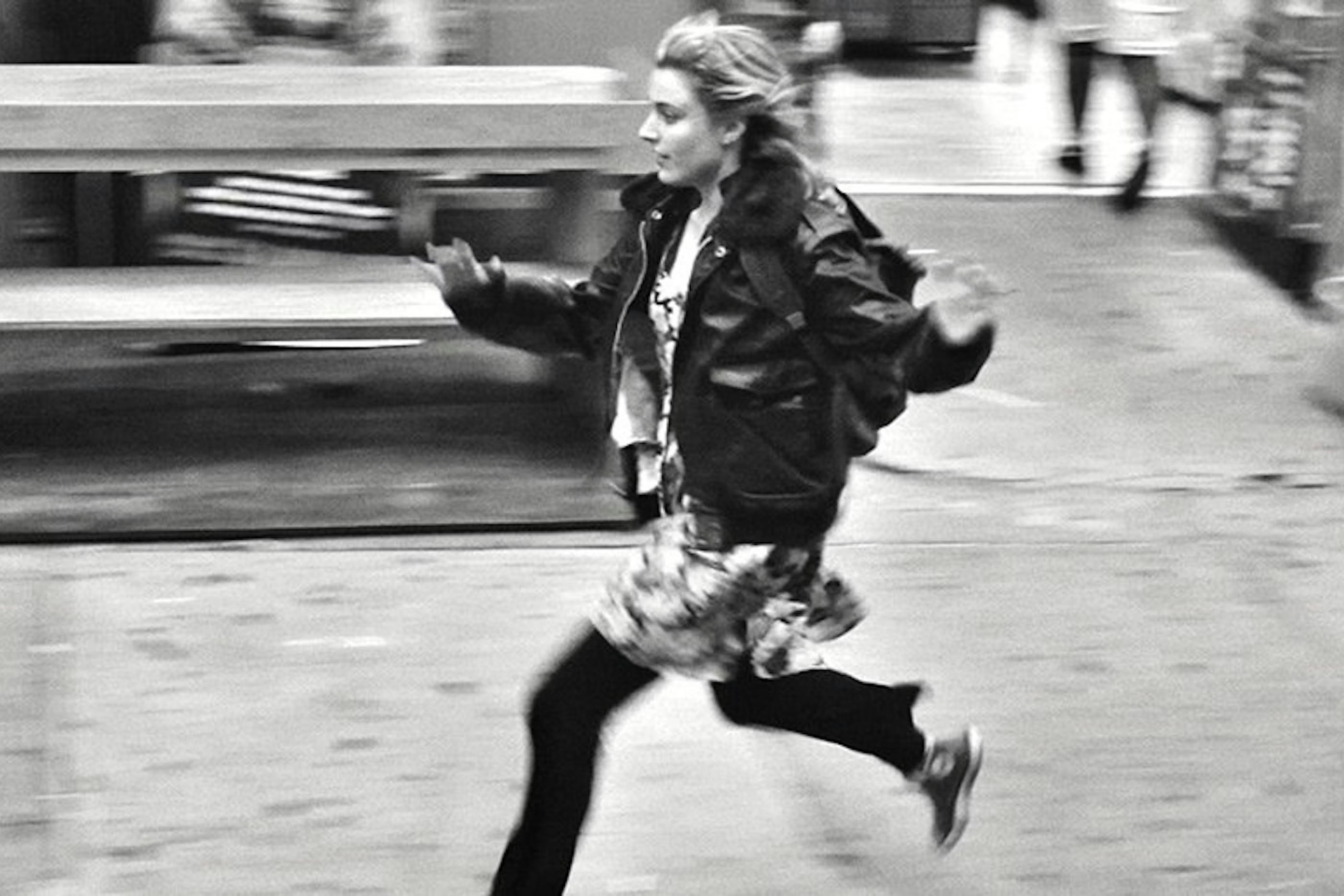
Crossing 7th Avenue onto Bedford Street on a summer day in New York City is entering a magic realm. The tops of the trees touch each other, forming a canopy that makes everything disappear — the rush of traffic, the blazing sun. It’s like getting tunnel vision, but the type of tunnel Alice in Wonderland would crawl through. My steps carry me through without thinking. Typically I’d arrive at this crossing from Soho, having walked down Prince Street. I continue through the Village, right on Grove, slalom to Bank, with its movie-set townhouses that I can’t help but imagine myself living in. Then down to the West Side Highway — the perfect distillation of what New York energy is all about — everyone moving with a force and self-possession that announces, without a word, that they are exactly where they belong. And then Pier 26, my favorite spot in the entire city. I stop at the water every time. There’s a wall there that says I want to thank you; I’ve never been entirely sure who it’s addressed to, or whether it matters. I look at the little cluster of buildings peeking through at One World Trade and I feel, briefly, set right.
I started doing this walk during the pandemic and it became the closest thing I have to a resurrection — reliable, repeatable, mine. Through the happiest times of the last six years, as well as the worst, I’d walk this route. Sometimes alone, most times with Emi. Most times talking, sometimes in silence. But no matter how hopeless we felt at the start, we’d inevitably feel better by the end. As if the city had lifted some of the heaviness, shedding bits of it at every pit stop — along the Village blocks, at the Pier, in front of our favorite Tribeca building.
When I was younger and dreamed of living in New York — drawn to it through movies and books — I wanted my life to feel like a movie. It sounds juvenile, but looking back I can tie that longing to something honest: wanting to live in a constant state of awe. There are novels, and then there’s a Paul Auster novel. There are movies, and then there’s a PT Anderson film. There are TV shows, and then there’s Succession. There are cities, and then there’s New York. Auster, who knew the city better than almost anyone, called it the nowhere he had built around himself — nowhere being, in his telling, the highest possible compliment. A place so total it dissolves the anxious self into something larger. If you want the best of what life has to offer, where else would you go? The city is not pretty, or clean, or calm. But it’s as honest as they come. It has bite.
That awe, that proximity to greatness, held me through the hardest times, both reminder and reason to keep going. In New York I lived more intensely than I ever had. I wrote. I did my best creative work. I built a business. And I never felt lonely. Not in a city where ambition is so densely concentrated it becomes atmospheric — where you absorb other people’s drive the way you absorb secondhand smoke, whether you want to or not.
But belonging to New York didn’t happen instantly, though it happened faster than anywhere I’d ever lived. I grew up in Bucharest, a place that couldn’t contain my appetite, and spent seven good years in London before Emi’s work brought us to New York. I didn’t need convincing. London I had chosen with my head; New York I said yes to with my whole body, before my mind had finished the sentence. It was, after all, New York. Within six months I wasn’t adjusting anymore. I was simply there, in the place I should have always been — the limitlessness of it making it feel more like home than where I’d come from. Years later, Emi’s work would require another move. This time to Austin. There was nothing to convince me of — the reasons were obvious, the math was simple, and we packed our bags. If Didion got to call hers Goodbye to All That, I only got goodbye to all that I love.
There is a particular kind of self-knowledge that only becomes visible when you’re somewhere that reflects you back. New York was that mirror for me — not flattering, but accurate. I arrived as someone still in the lightness of her twenties, the entire future spread out with no end in sight, still able to postpone things, still allowed to make mistakes and change course. The city received all of that and then, at some point I can’t quite locate, began to demand more. Or perhaps I did, and the city was simply the place where the bill came due. No terms are announced, no warning given. You just wake up one day and the stakes are higher than they were, and you either rise to meet them or you leave.
I shed my youth and my naivety in New York, traded them for the pressure of real responsibilities. I let it inspire me to write and followed that thread, only to fail to get into film school. I worked jobs I didn’t like. I remember the summer of 2023, making the rounds to investors’ offices all around the city, sweating through the unforgiving July heat and having door after door slammed in my face. The city is like that too, marvelous but harsh, offering everything at your feet but never for free. Greatness doesn’t just rub off on you if you’re not cut out for the grind. The reflection showed me I was in the right place — but I’d have to keep earning it.
My sense of identity has always felt naturally intertwined with the city — treading the same streets as my favorite writers and artists, walking everywhere, absorbing the energy. The fact — not just the idea — that you can, in a single day, work, meet remarkable people, walk into your favorite bookstore, slip into the Met just to stand in front of your favorite painting, spend your evening marveling at a Balanchine piece at New York City Ballet, and walk home through Central Park somehow even more alive than when you woke up. I didn’t know then that those days would not be infinite.
Like anyone leaving behind something they loved, I tried to convince myself in the months leading up to the move that a respite from New York’s relentlessness would be welcome. I pictured Lady Bird Lake, people strolling alongside the water as if nothing were ever pressing or important; full of sunshine, ease, and mothers pushing strollers down leafy streets past houses that seem always asleep. I told myself the trade-offs would be worth it. More space. A house with a backyard. A sauna. Cooking all our meals at home. We ended up moving into an apartment in the most walkable part of the city, no backyard, no sauna, and I still prefer reading to cooking.
People talk about longing for a place you’ve left as if it were nostalgia — soft, vaguely embarrassing, the province of people who can’t move on. But what I feel isn’t the shapeless ache of someone pining for a past self. It’s more precise than that. It’s the feeling of walking around without a mirror. Of knowing exactly who you are and having nowhere to see yourself.
Austin is not a city of culture or energy or creation. It is a place built around a particular vision of the good life — and the version of me that vision requires is the domestic one, the one who has traded the Met and New York City Ballet for a nursery and a baby. I came here to step into that life. I am still waiting to. And in the meantime I have neither — not the city that made me, not the life I moved here for. I wake up surrounded by the same things I had in New York, and then I look out the window. A big flat nothing. I walk to the gym on a dirt trail with insects buzzing in my face — where others would see nature, I see countryside. I take driving lessons because I now live somewhere that requires a car, even though cars terrify me. There’s no bookstore to walk into, no mirror to reassure me that I’m still there.
Last week I stopped by the grocery store. There were no bags at the checkout. I asked the cashier for one. She handed me a cardboard box. I said, what am I supposed to do with this? She said, carry your groceries to your car. I said I didn’t come by car. She replied: well, I don’t know how you got here.
I said Uber. But in my head I thought: yes — I don’t know how I got here either.
The only things that are here are Emi, my books, my writing, and the waiting.
I’ve been told many times that raising children is easier in a place like Austin. The space, the schools, the slower pace. But I keep thinking about what New York gave me — not just the experiences, the education of walking those streets — but the bite. The particular quality of a person shaped by a city that demanded the best of them. That is what I want to pass on. I’d rather my children have bite than a backyard.
And so the walk on Bedford Street, every time I manage to get back to it, remains the closest thing I have to seeing myself clearly. The canopy closes over my head and everything disappears — the waiting, the uncertainty, the in-between. For the length of one walk, the city lifts the heaviness, the same way it always has. And for a moment I am not suspended between two lives. I am just here, moving through the place that made me, still myself.
❤️❤️❤️❤️❤️