

Until 34 years old I felt 26. Then, all at once, I didn’t. The feeling, more akin to panic than a simple realization, came unannounced. I saw lines on my forehead that hadn't been there before, and felt frightened equally by their insidiousness and by how badly I wanted to erase them, each one a foreshadowing of everything that would become softer, saggier, lesser. The inevitable progression from looking youthful, to looking good for one’s age, to invisible.
Growing up, I remember strangers complimenting my mother, saying she looked 20 years younger, or that the two of us walking down the street together could have been sisters. I’d also eavesdrop on conversations between grown women talking about so and so whose husband had left her for a younger woman. Sometimes it was the woman’s fault, they said, for not taking care of herself or the marriage; most times it was simply what men did. Back then we didn’t know about preventative facelifts at 30, but the message was the same: preserve your youth to preserve your value.
If vanity can be stoked in myriad ways, there is no cosmetic procedure for walking out of a doctor's office at 35 newly classified as "advanced maternal age." Even if I could prevent my wrinkles from getting deeper, at least for a time, I couldn’t undo that label. Or the pregnancy losses, or the struggle to conceive. And since botox is off the table while I’m trying — a fact nobody lingers on when they’re busy telling you how common all of this is — the lines are only getting deeper, my body running its own agenda on both fronts simultaneously.
Alongside the pain, the losses came with a level of guilt I hadn’t anticipated — shame at a body I had thought was simply mine, now revealed as capable of failing me in ways I hadn't expected. What did it matter that I had felt 26 inside when half of my eggs were already bad? I was angry at how differently my husband and I had each lived through this. The desire itself seems so much less complicated for him — less ambivalence, fewer questions about how having a child would shift his identity. To him, the difficulty was simply nature being nature — flawed, prone to error, not something to be ashamed of. He has experienced loss and grief too, but the shame is mine alone.
Men struggle with aging too — there are midlife crises and, more recently, facelifts and looksmaxxing and peptides and compulsive longevity chasing. But the fact that a 45-year-old man can, and often does, choose a 25-year-old woman to procreate with while the opposite is never true says more about the different ways we experience aging than any hypocritical attempt to convince us we are equal in our fear of it. Grey hair and wrinkles and softer bodies are not perceived with the same apprehension in men as they are in women, and even if they were, nature has made sure we lose our viability much sooner.
We live longer, we have children later. Age is just a number, we are told, ad nauseam. And yet age still defines the most consequential things a body can do. Even without the reproductive stakes, the body finds its own ways to mark time — each grey hair, each new line arriving as evidence of a clock you cannot slow, a magnifying glass held to whatever fear lives underneath. The fear of becoming undesirable, or unlovable, or more painfully, unrecognizable: the image in the mirror at odds with the one in my mind, not even the 26-year-old I’d stayed inside, but something younger, already falsified by longing.
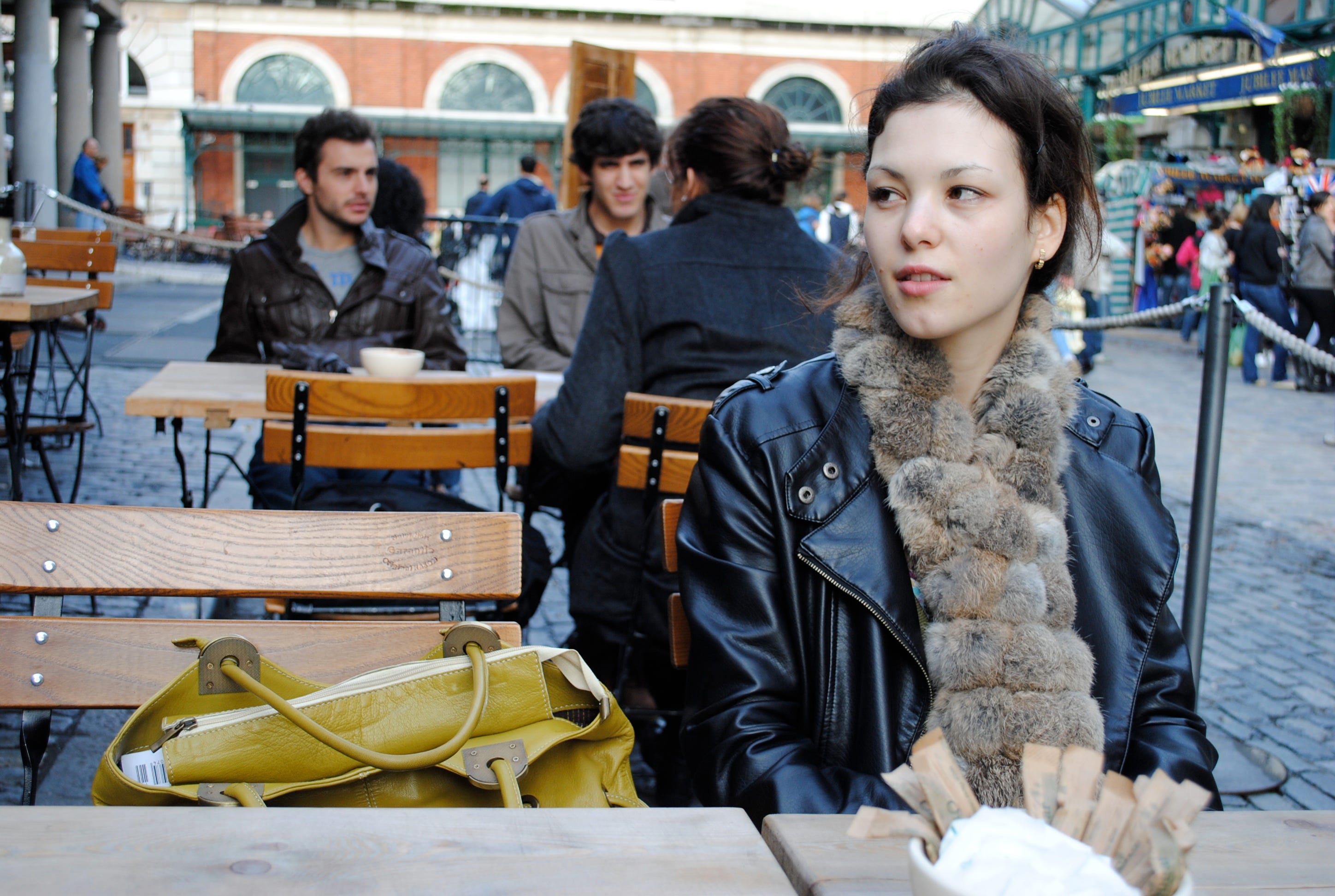
The deceit runs deeper than the body. I know this because I keep returning to a photo of me at twenty, living in London. There is a leather bag in the photo that I hated — a gift I carried because I had nothing else. I knew my picture was being taken, and yet there is something in my expression, something not yet closed off, not yet monitoring itself, that I cannot replicate now. Looking at it, my heart crumples in a way that looking at a photo of myself now simply doesn’t. Me then — a still from a film I am directing from memory. Me now — just a photograph. I wasn’t happier then, I wasn’t feeling more at home in my own body, I wasn’t less depressed or sad. But I was always the youngest in any room, currency I had no idea what to do with, and that, in retrospect, wasn’t only about vanity or the smooth skin on my forehead. I look at that version of me, see her running around London in her ill-fitting clothes, heartbroken and broke, and remember the feeling — the delight of not knowing, of experiencing life as a string of surprises.
Nostalgia is a trap — the same one that makes us remember the dead as better than they were. I don’t romanticize my youth, I haven’t forgotten the hardships, and I don’t believe that struggling is virtuous, but I do long for that feeling. It wasn’t just freedom, although that was part of it. What it felt like was my whole life still undetermined, the sense that I could still become anyone, that I could change my mind about anything as many times as I wanted. The tally of mistakes hadn’t yet accumulated; I felt unencumbered by responsibilities or the weight of my poor decisions.
My husband tells me this feeling was always an illusion — that we are never on any path but the one we were already on, that the other lives were never really available. He is right. And it doesn’t change or deny the feeling of abundance and discovery I had in those years. The open future might have been a mirage, but it was fuel I didn’t know I was running on, and knowing now that it wasn’t real doesn’t return it. At almost 36, I feel less at odds with myself and the world. I feel safer, more at ease, more focused on the things that matter now. I have more of everything. Except time. And that feeling. I know what’s coming, and where that should make me feel peaceful, it also makes me sad — a path already laid out, decisions already made, simply forging ahead toward what I can see coming.
Youth is not just beauty or freedom — it is the feeling of being in front of your life rather than inside it, and once you are inside it, you cannot get back to the front. If I’m still the girl in the photo, I only exist as a memory, a set of questions to grapple with now: did I do everything I thought I was going to do? Have I lived enough, taken enough risks? Do I have anything to say that makes the distance between then and now worth something?
The consolations are not hard to find. Other women’s words, other frameworks, other ways of making the loss mean something. In 1972, Susan Sontag offered this one:
Women have another option. They can aspire to be wise, not merely nice; to be competent, not merely helpful; to be strong, not merely graceful; to be ambitious for themselves, not merely for themselves in relation to men and children. They can let themselves age naturally and without embarrassment, actively protesting and disobeying the conventions that stem from this society’s double standard about aging. Instead of being girls, girls as long as possible, who then age humiliatingly into middle-aged women and then obscenely into old women, they can become women much earlier-and remain active adults, enjoying the long, erotic career of which women are capable, far longer. Women should allow their faces to show the lives they have lived. Women should tell the truth.
What truth, exactly? Because the truth is, one is not more precious than the other — wisdom over youth, confidence over wrinkle-free skin, safety over freedom. These are presented as exchanges, as if you get one thing in return for losing another, but the accounting never balances. The feeling of being at the beginning cannot be replaced. I have to live with the certainty that I have not done enough, have squandered what once felt infinite. It is greedy and immature, wanting that lightness instead of welcoming what’s coming, the dull rhythm of grown-up life. I will have children despite my advanced maternal age, I will change diapers, not sleep, forget how to write or even have interesting ideas, and my children will grow up, and I will probably not get a facelift, and maybe — just maybe — a kind stranger will comment that my daughter and I look like sisters.
The longing doesn’t ask permission.
I recently had a dream that I was hunting for an apartment in a neighborhood in New York I once lived in. I found a place that was in fact an office space, small, cramped, with no bedroom. Instead, a bed lay on top of the rooftop. I climbed in and looked at the city around me and realized I couldn’t stay — I was too terrified to sleep there, to accidentally roll over and plummet to my death.
As someone currently 36, with an almost 2-year-old, a job that doesn't fulfil me in any way, and in a relationship that will be legally registered towards the end of the year, I just wanted to comment and say that I feel exactly the same. I am at the point where I'm looking back at my early 20s living in a big city far away from home, the city offering itself to my potential, my imagination, the future unwritten yet, and I cannot help but feel a bit sad. I often go about my day with the daily routine, work, drop off child at nursery, log on, do work, log off, and in the middle of day I get sudden - I would call them electrical impulses in the brain but that would be factually wrong - pangs of nostalgia. Of remembering there was a time when the unknown was in front of me, and I was young, and I was carrying an insurmountable amount of self-doubt and anxiety about the future, and I wish I could for a moment return there, and feel that freedom again. But I chose this life, and I know more or less the direction it's headed in. I can't, however, help but sometimes casually fantasise about all the parallel lives that I could've lived had I made different choices. But to quote something I read (and won't ever forget) in a book Cheryl Strayed wrote, "that other life isn’t yours. I'll never know of the life I didn't choose. We'll only know that whatever that sister life was, it was important and beautiful and not ours. It was the ghost ship that didn't carry us. There's nothing to do but salute it from the shore." I don't want to say anything unhelpful about wanting to have a child, as I'm sure you're constantly being bombarded with all sorts of advice, except that it will happen. Mine came as an accident, an answer to a question I was always asking myself: do I want to be a mother? The experience made me acutely aware of my own mortality, of my body aging, of a failing placenta towards the end, and of me constantly doubting if perhaps I waited too long to get the answer. Yet somehow things settled and worked out. I wish you nothing but luck (as it's a numbers game) and patience.
I can only agree because you wrote it so well. ❤️❤️❤️