

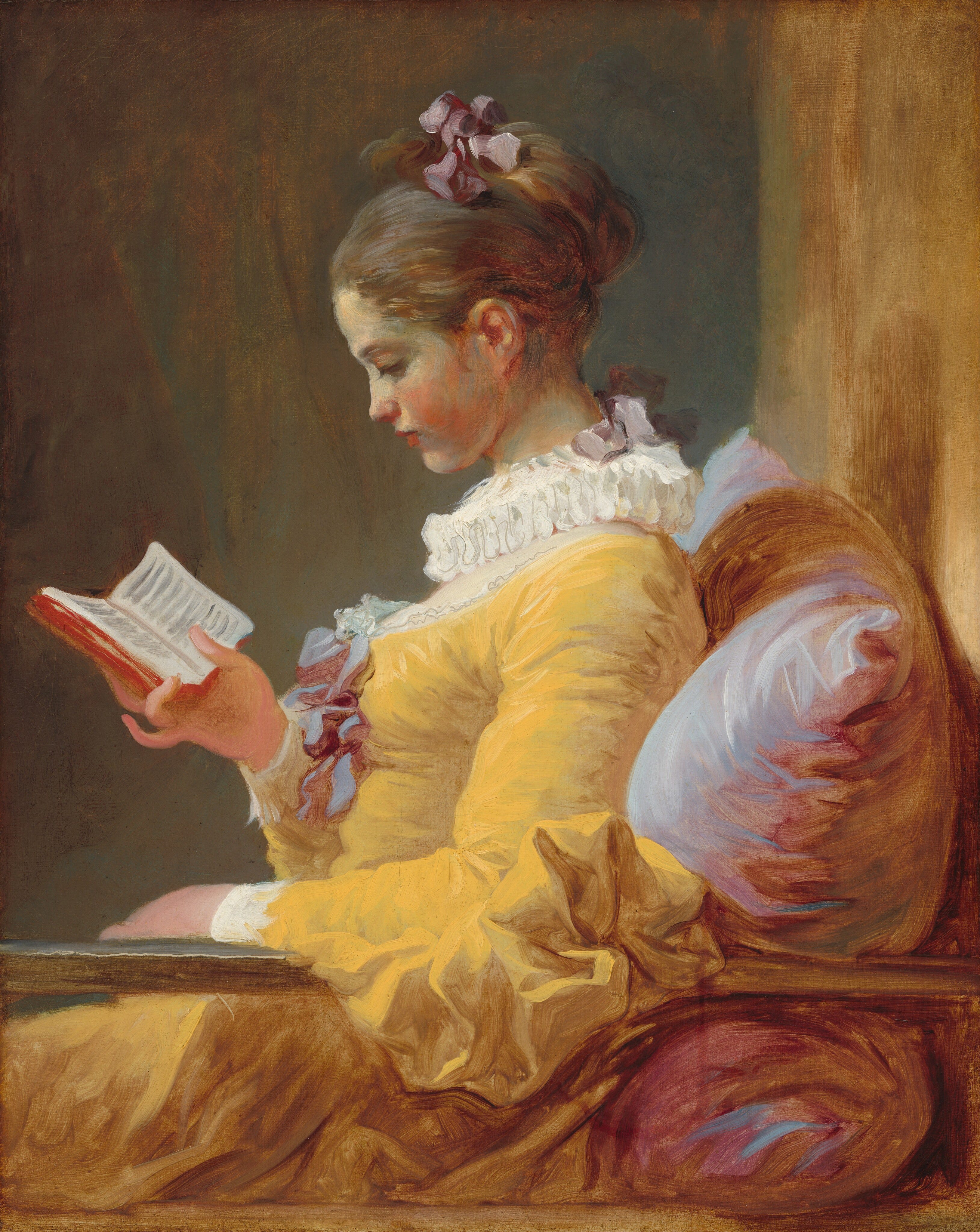
A memory: finishing a book and asking my mother what I should read next, her walking me to our overflowing bookshelves and choosing my next one. Or me saying “I’m bored” on a lousy summer day and her reply: “pick up a book.” Or her placing a stack of new books on the low table by the sofa and me wanting to copy her — not only in the excitement of possessing them, their smell still fresh and unbroken, but in the anticipatory pleasure of having something to look forward to. Or getting the flu in fifth grade and being allowed to stay home for an entire week, bedridden not so much from illness as from the Lord of the Rings, which I had been given as a gift and refused to put down, my mother asking whether I was truly reading each page or skipping through.
I was read to from infancy, by either my mother or my grandmother. The Brothers Grimm fairytales, a book so large and dog-eared I had learned it by heart. Like all children’s stories, everything concluded with some moral wisdom to help you become a good person. But what I really cared about was the magic — the seven sisters turned into swans who could no longer speak, the magic cabbage that could guide you home no matter how far you’d wandered. Yes, the characters had to be brave, had to own up to their mistakes and eventually become the good people all stories require, but the world they inhabited was so rich and mysterious that it made all the effort toward goodness feel exhilarating.
The first novel I read on my own, at seven years old, was Heidi, by Johanna Spyri. Almost thirty years later, I can still smell the cheese Heidi shared with her grandfather in the Swiss mountains, see the meadows she ran through with Peter, and relive both the heartbreak of her separation from her grandfather and the thrill of her life with wealthy, wheelchair-bound Clara in an opulent villa in Frankfurt. While living with Clara, Heidi develops such a severe case of homesickness that she begins sleepwalking. For all my earnest attempts, I could not make myself sleepwalk, nor could I locate any wealthy relatives to be sent away to — but Heidi became a different kind of portal, one that led me to discover a reality far more exciting than my own: the one inside books.
If Heidi planted images that lodged themselves in me before I had the vocabulary to explain why, my world was turned upside down at ten when I unwrapped the first Harry Potter volume from under the Christmas tree. The memory of reading it unfolds on two simultaneous tracks — the magnificence of the story, unlike anything I’d encountered, a magical world existing not in some faraway land but inside our own, and then the actual experience of reading it, an awe and joy so total I have never been able to replace it. By the time the last book was published I was old enough to know that Hogwarts didn’t exist. But part of me has never quite accepted this. That hope has kept me reading ever since.
There isn’t a single period of my life that hasn’t been marked by books. If as a child transcendence meant fiction becoming more real than reality, as I began choosing my own books it morphed into something different — the discovery that whatever I was feeling, someone had already written it down. The rawness of first love mapped onto Wuthering Heights and Atonement; the suspicion that life might be meaningless finding company in Dostoevsky and Camus. And then there were the desires fiction satisfied that reality couldn’t — the hunger to see the world, met by Hemingway’s Paris, Márquez’s sensual landscapes, Fowles’s Greece, more solar and unchaste than the Aegean I finally swam in years later.
Coming of age through the classics is hardly singular, in the same way that wanting to write as a result of spending so much time among books has afflicted many other young people. But whether or not it made for a unique fate, it shaped my worldview and laid out the foundation for expanding my emotional range. It wasn’t therapy, or even my parents’ divorce, that taught me more about the complexity of relationships than Amos Oz, Julian Barnes or Rachel Cusk. I could see my mother’s entrapment in every female character Oz wrote — someone who married into a life she consciously chose but couldn’t emotionally inhabit, where nothing dramatic ever happens, only an accumulation of small, continuous mismatches that silently compound into unhappiness. That a man could render female complexity with such poignancy made the difficulty of so many relationships feel complete and true — it is not through a failure of understanding that we arrive at painful dissolution. We understand each other perfectly. There is simply nothing we can do to prevent the hurting, in spite of it.
I’ve heard people say they prefer nonfiction because it’s about real life. A friend recently mentioned a study showing that college students — including those in literature programs — arrive at university having rarely finished a book. I understand the instinct toward the factual, the verified, the directly useful. But life is not information. Its texture is made of something harder to locate — the things withheld, the contours of our relationships, the contradictions that accumulate into something irreversible. The woman who first placed a book in my hands was also someone I later found in other people’s fiction. That is real life.
What does it feel like to live without the particular interiority that literary fiction constructs? Can you even know what you don’t have?
Take Anna Karenina, a novel that illuminated more about women than was ever permitted to surface in the real world. Reading it as a teenager, I recognized something: the hunger, the non-compliance, the refusal to be what the world needed her to be. But I received it as tragedy, as the inevitable cost of being ungovernable; she was living in a corset, figuratively and literally, and there was no other ending available to her. What Ferrante gave me, years later, was the same woman without the corset, still complicated, still impossible, but alive and unresolved, the tragedy not death but survival — having to live as a woman who wouldn't simplify herself. Ferrante doesn’t stand back and observe from a distance, she’s inside, and the Neapolitan novels give you female ambivalence without the elegiac frame, messier and uglier and more embarrassing, more accurate. Elena is not magnificent. She’s petty, envious, self-deceiving, sexually complicated, a bad mother at times, a woman who can’t decide whether she wants to escape her origins or be forgiven for escaping them.
But admiring these writers as a reader and attempting to follow them as a writer are two very different relationships to the same work. Didion taught me what a sentence could do. She also made it nearly impossible to write one. The pleasure of being inside language — Nabokov’s lyricism paired with absolute linguistic control, Woolf’s fluid rhythmic prose, Knausgård’s precision through accumulation, Didion’s surgical clarity, which would eventually give me a name for what I had been chasing all along — has come at a cost. The more I read, the harder it becomes to bridge the gap between what I admire and what I am able to produce. The aperture that once seemed possible to close has widened into a chasm, and with every sentence I read I am newly aware of how mine fall short. If reading is all delight, writing is its opposite — the faint impression of it manifesting only in those rare instances when an idea feels fully formed, when I arrive at something previously inaccessible.
The trade-off is not always knowing how my ideas formed, my inner life having been so thoroughly shaped by other people’s fiction that I am left wondering what is distinctly mine. Perhaps this is just how consciousness works for everyone, and readers are simply more aware of it, since original thought is mostly fantasy. Writing a sentence and being unable to tell whether I thought it or absorbed it serves as an inconvenient but necessary check — I don’t get to take credit for arriving somewhere if the idea likely originated elsewhere. But questioning why I am drawn to it, finding how to express my version of it, that remains a satisfying effort.
The question of identity can be posed differently then, not through ideas but through the sense of being someone who reads, a self-concept so thoroughly mine now that I can’t separate it out and examine it. It’s not a skill I have. It’s the water I swim in. If it’s made me a snob, I’ll take it, because reading has given me things I can name and account for — a way of paying attention, a vocabulary for feeling, a standard to aim toward. But the thing it has given me that I value most has no clean name. Didion called it the shimmer: that ineffable image standing in for emotion, the simple detail that holds something too large to be said directly. At seven it was Heidi’s cheese. Then it was Tolstoy’s candle — the last thing Anna sees before she dies, everything he wanted to say about her life, its brightness and brevity and the way the world extinguished her, held in one image he never explains. Didion’s shoes: she doesn’t throw away her dead husband’s shoes because he’ll need them when he comes back. Auster, in The Invention of Solitude, finding a photograph of his father as a young man that doesn’t look like his father, a man so unknowable that even his own face in youth is a stranger. Fiction doesn’t tell you about human experience. It creates the conditions for you to have it. I keep reading because I keep looking for the next one — the image I haven’t found yet, in the book I haven’t opened yet, that will make my heart sink.
I keep looking for your next one ❤️❤️❤️